
Walk into the back office of almost any stone showroom and you'll find the real product catalog: a spreadsheet. Maybe several. One tab per brand, a folder of supplier PDFs, a printed price sheet with handwritten notes in the corner, and one person who "knows how the pricing works." It functions, until it doesn't.
The strange part is that everyone knows it's fragile. So why does it persist?
Every brand speaks a different language
The root problem is that stone brands don't price the same way. Some publish an MSRP; others don't. Some organize by color group, others by series. Thicknesses and finishes are named inconsistently. Each supplier sends updates on its own schedule in its own format.
Faced with that, showrooms do the only thing they can: they flatten it all into a spreadsheet they control. It's a rational response to chaos. But the spreadsheet inherits every one of those inconsistencies, plus a new one, it's only as current as the last time someone manually updated it.
The hidden costs
Spreadsheets feel free because you already own them. The costs show up elsewhere:
- Slow quotes. A salesperson juggling tabs and PDFs takes real minutes to price a job, minutes the customer spends losing momentum.
- Pricing that drifts. When cost lives in one file and the price list in another, staff estimate instead of know, and two salespeople can quote the same slab differently.
- Stale pricing. Supplier updates lag. The number your team quotes on Tuesday might be last quarter's.
- Key-person risk. When the one person who understands the pricing logic is out, the whole floor slows down.
- No visibility. A spreadsheet can't tell you what's selling, what's not, or which brands actually move.
None of these are dramatic on any single day. They're a slow tax you pay forever.
What a real catalog looks like
The way out isn't a better-organized spreadsheet. It's a single system where every brand lives together and the pricing is always current.
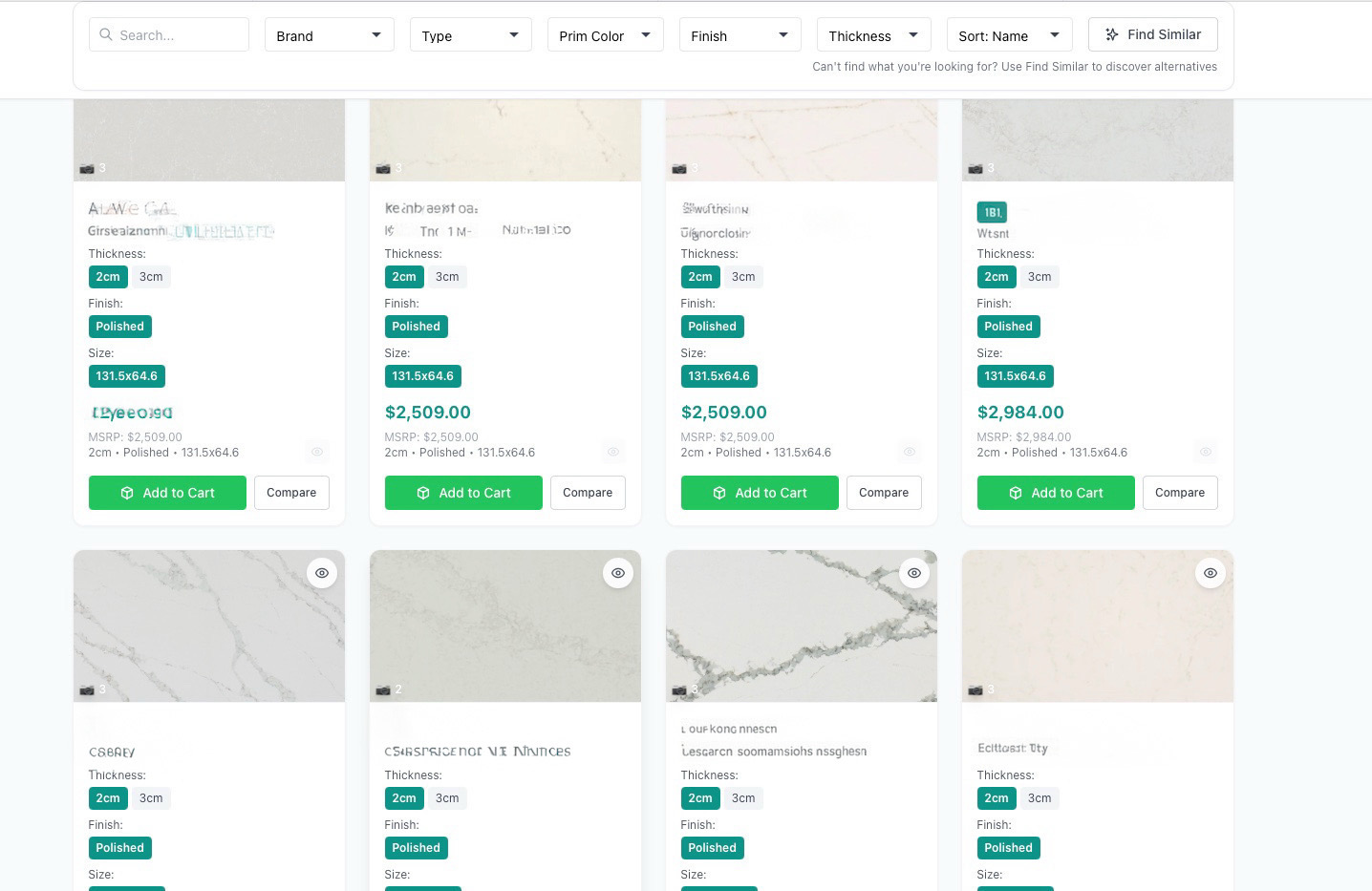
That's the idea behind the StoneOS wholesale catalog. Every brand you carry sits in one searchable catalog. Your real showroom wholesale cost and the client-facing price appear side by side, so nobody has to guess. You filter by brand, stone type, color, thickness, and finish and land on the right slab in seconds.
The difference on the floor is immediate. Instead of "let me go check the price," it's a number on screen, right now, with cost visible only to the people who are allowed to see it.
Control over who sees what
One reason showrooms cling to spreadsheets is control, they don't want wholesale cost visible to everyone. A good catalog handles that better than a locked file ever could. In StoneOS, wholesale-cost visibility is a per-team-member setting. Your salespeople get the full catalog and client pricing; cost stays hidden unless you grant it. No shadow copies, no "don't open that tab."
From catalog to quote without retyping
The spreadsheet's final weakness is that it's a dead end. You look up a price, then retype it into a quote somewhere else. A real catalog flows straight into quoting: the stone you find becomes a line on a live quote, with pricing carried through automatically. One source of truth, from browsing to quote to order.
Making the switch
The fear with replacing a spreadsheet is losing the control and familiarity it gives. In practice, showrooms tend to find the opposite. A live catalog gives them more control (current pricing, cost masking, one source of truth) with less effort (no manual updates, no format wrangling). The familiarity you'd be giving up is mostly the familiarity of the workarounds.
The spreadsheet was a reasonable answer to a real problem back when there was nothing better. It just keeps charging you rent, in slow quotes, stale prices, and numbers nobody fully trusts. That's the part worth fixing.
The Wholesale Catalog page shows what the unified version looks like in practice.