
There's no dramatic moment when a showroom deal dies. No slammed door, no angry email. It just quietly fails to happen. The customer says "I'll think about it," walks out with a friendly wave, and never comes back. On paper it looks like a maybe. In reality it's usually a no, you just didn't get to hear it.
"I'll think about it" is the most expensive sentence on your floor. Understanding what it actually means is the first step to beating it.
What they're really saying
"I'll think about it" almost never means "your price is too high" or "I don't like the stone." Most of the time it means one of two things:
- "I can't picture it." They love the sample but can't see it in their own kitchen, so committing feels risky.
- "I need to talk to someone who isn't here." A spouse, a designer, a contractor, the real decision-maker didn't make it to the showroom.
Both are legitimate. And both are solvable before the customer leaves, but only if you give them something concrete to take home instead of a vague memory.
The problem with letting them "think"
The moment a customer leaves your floor, entropy takes over. Excitement cools. The sample they loved blurs together with three others. A competitor's follow-up lands in their inbox. By the time they "think about it," the emotional peak that would have closed the deal is gone.
The traditional response, a follow-up call a few days later, often arrives after the decision has already drifted. You're not reviving momentum; you're interrupting someone who's mentally moved on.
The better move is to make sure they leave with the decision half-made and something real in hand.
If they can't picture it, show them
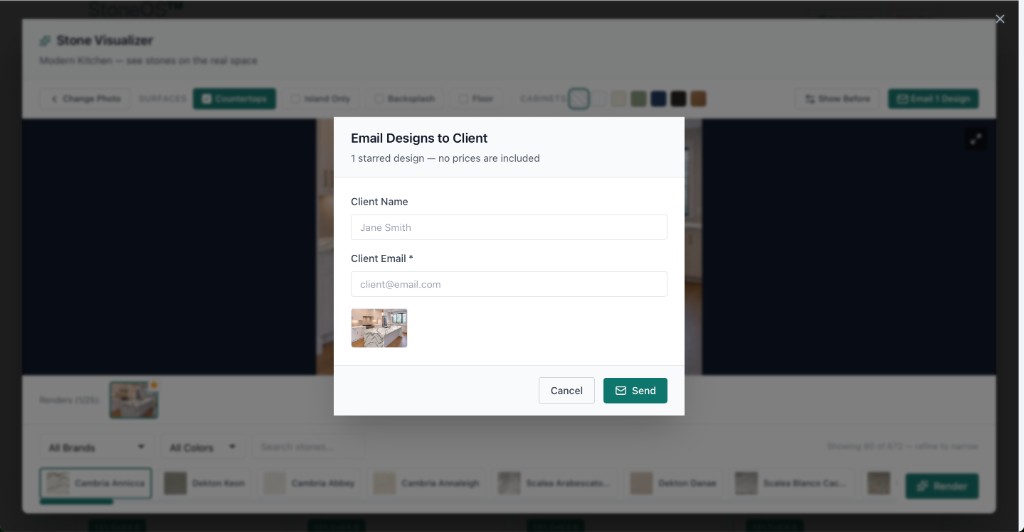
When the real objection is "I can't picture it," the answer is to remove the picturing altogether. The StoneOS AI Visualizer renders any catalog stone onto the customer's own kitchen photo in about ten seconds, countertops, island, and backsplash together, in their real light.
Then you send it home with them. Your team stars the favorites and emails the renders, deliberately without prices. Why no prices? Because a render of their dream kitchen is emotional and specific; a price list is a negotiation. The customer goes home and shows their partner an actual image of their kitchen with the new stone in it. That's a decision aid, not a bill.
Now "I'll think about it" comes with a picture attached, and the person who wasn't at the showroom gets to see exactly what their partner fell in love with.
If they need to consult someone, arm them for it
When the holdup is "I need to talk to someone," give them something to present. With instant quotes, your salesperson builds a live cart at the counter and emails a branded stone comparison, your logo, the options side by side, the client pricing laid out clearly.
The comparison email does two jobs. It arms the customer to make the case at home, and it keeps your showroom's brand in front of them instead of a generic PDF. When they're ready to move, they reply to you, not to whoever they happen to search next.
Two emails, two purposes
Used together, these become a one-two punch that respects where the customer is:
- The visualizer render email (no prices) sells the vision and closes the imagination gap.
- The comparison email (with client pricing) supports the practical decision and keeps you in the conversation.
The customer leaves with both, and their at-home "thinking" happens inside your materials instead of a competitor's search results.
Change the exit, change the outcome
You won't eliminate "I'll think about it", some customers need time. The goal is to change what "thinking about it" looks like. Instead of a fading memory and a business card, they go home with a photorealistic image of their own kitchen and a clean, branded comparison of their favorites.
That's a customer who's still deciding with you, not drifting away from you.
Next time you hear "I'll think about it," assume it's one of those two things and not a price problem. Handle both before the customer reaches the door, with a render that sells the vision and a branded comparison that supports the practical decision, and you'll win a lot more of those follow-ups than you lose.
The AI Visualizer and Instant Quotes pages go deeper on each half of that.